
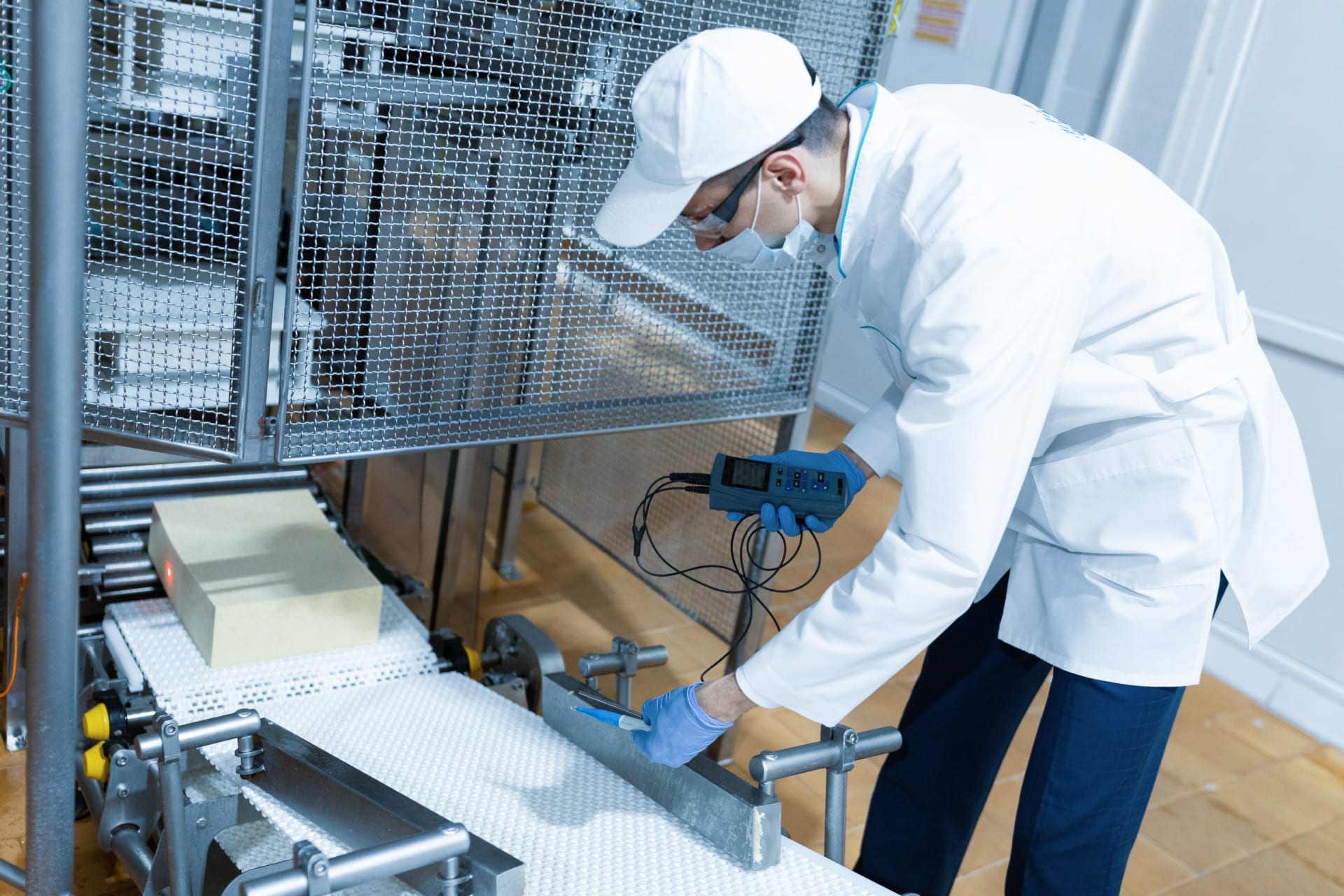
Conveyors are one of the most overlooked surfaces in food plant cleaning. Food safety audit findings related to conveyor belts are among the most common repeat non-conformances. They’re also almost always traceable to the same root cause; no clear owner, no documented method, no verified sign-off.
We cover where conveyor belt cleaning typically fails and what a structured programme looks like. The main aim is for you to measure whether yours is working and conduct a thorough assessment of this vital piece of equipment.
Key takeaways
Conveyor belts are among the highest-risk surfaces in any food manufacturing facility and are consistently under-cleaned. A programme that works requires defined ownership, realistic time windows, a documented method that produces the same result regardless of who is on shift, and the KPIs to tell you when staff are not adhering to the procedures.
Why do conveyors get skipped in commercial cleaning plans
Constant contact with product and packaging creates high exposure
Unlike most equipment in a food processing facility, conveyor belts are in near-constant contact with your product and packaging throughout every shift. That continuous exposure means any build-up on the belt surface has a direct pathway to your product across every cycle.
For food manufacturers operating under recognised food safety standards, the conveyor belt is one of the highest-risk surfaces on the line. Yet because it’s always moving, always in use, it rarely gets the same structured cleaning attention.
Hidden surfaces routinely get missed
The surfaces your staff can’t easily see are the ones most likely to fail you in an audit. On a conveyor, that means the underside of the belt, the rollers, the tail pulley, and the space between the belt and the frame. These are the surfaces that separate a “clean” conveyor from a compliant one.
The accountability gap killing your conveyor belt hygiene
The working shift assumption problem
The handover between day shift and night shift is one of the highest-risk moments in any food manufacturing operation. In the absence of a formal sign-off process, both shifts operate on the assumption that the previous shift cleaned and rely on surfaces being visibly clean.
The problem is structural. Without a documented handover that explicitly captures conveyor cleaning status, the gap between shifts becomes a gap in your food safety programme.
What happens when there’s no sign-off process
When there’s no formal sign-off process for conveyor cleaning, the programme exists in name only. In practice, the absence of a sign-off process means that cleaning tasks get completed to whatever standard time and pressure allow on a given shift, with no mechanism to catch shortfalls before production restarts.
There’s no data to show an auditor that your facility is consistently executing the programme. For food manufacturers operating under FSSC 22000 or AIB standards, all of these standards require documented evidence of cleaning effectiveness.
How accountability gaps show up in audits
Auditors can distinguish between a plant with a conveyor cleaning programme and one with an actual working programme. A repeat finding at the same roller or transfer point across two consecutive audits is evidence that your facility never addressed the root cause, indicating a direct accountability gap.
Incomplete cleaning records, inconsistent sign-off sheets, or cleaning records that don’t align with physical inspection findings are patterns that auditors from BRC, AIB, and FSSC focus on identifying.
How to zone a conveyor for cleaning
The initial risk of in-feed zones
The in-feed zone is where the product first makes contact with the conveyor, making it the point at which contamination risk is introduced earliest in the process. Product is loaded here, and with that comes the inevitable transfer of loose material, moisture, and organic debris onto the belt surface and the surrounding structure.
Spillage at the in-feed is routine, and in a busy production environment, teams rarely treat it with the same urgency as a spill elsewhere on the line. The underside of the belt at the in-feed pulley is another consistent accumulation point. Food product that misses the belt or wraps around the pulley builds up quickly and is rarely visible during a walkthrough inspection. For food manufacturers, the in-feed zone sets the hygiene standard for everything that follows on that line.
Transfer points
Transfer points are the gaps between one conveyor and the next, where product moves from belt to belt or from belt to chute. Transfer points are structurally complex and almost always awkward to access during a standard cleaning routine. Product debris falls into the gap, accumulates on the underside of the receiving belt, coats the nose roller, and builds up on any horizontal surface in the surrounding structure.
What makes transfer points particularly problematic from a food safety standpoint is that the accumulation is largely invisible during normal production. By the time the build-up is significant enough to be noticed, it has often been there long enough to compromise the integrity of the product passing over it.
The contamination risk of out-feed zones
The out-feed zone sits at the end of the line, which, in most food plants, also means it sits at the end of the cleaning priority list. By the time a commercial cleaning team works through the other systems, the out-feed often receives whatever time and attention remains, which, in a tight changeover window, is rarely enough.
This zone carries significant risk. The product that has travelled the full length of the belt arrives at the out-feed carrying any residue it has collected along the way. The tail pulley and the underside of the belt at the discharge point accumulate this material.
Structural surfaces
Structural surfaces are not in direct contact with the product, but are a consistent source of harbourage risk. Residue migrates to these surfaces through splashing and direct contact during loading and unloading.
In wet plant environments, moisture collects in these same spots, creating conditions for biofilm development. In dry plant environments, dust and product fines accumulate in corners and crevices that a cloth or brush passes over without penetrating. The structural surfaces of a conveyor are also where pest activity is most likely to go undetected.
Changeover routines that actually stick
Why cleaning fails during shift changeovers
Most changeover cleaning failures can occur when procedural failures exist before cleaning begins. It could be that the cleaning scope was never clearly defined for that specific conveyor, the chemicals and equipment needed are not staged and ready at the line, or even that the person responsible for cleaning is also responsible for three other tasks that production needs to complete before the line restarts.
By the time cleaning actually begins, the entire process is already on its back foot. Ideally, cleaning routines should have fixed requirements that your production schedules are built around.
Building a routine around production schedules
The most common reason cleaning routines break down in food manufacturing is that office teams typically produce them in isolation from the realities of production. A programme developed without input from the people running the line will almost always conflict with how the shift actually operates.
Building a routine that actually sticks means starting with the production schedule and working backwards. That could be:
- When does the line stop?
- How long is the realistic window before it needs to restart?
- What are the highest-risk zones that teams must clean within that window?
- How can your team schedule a daily or weekly deep clean without compromising food safety between changeovers?
Allocating time windows that are realistic for your line
A cleaning task that your team can’t complete within the allocated time will be either rushed or skipped. Both outcomes carry the same food safety consequence.
The starting point here should be a time-and-motion assessment of what a thorough clean of each conveyor zone actually requires. That allows your team to have actionable data vs. copying another facility’s blueprint or estimating the time required. Different conveyors, different product residues, and different facility layouts produce genuinely different cleaning times.
Once your team establishes realistic time requirements, they need to protect the production schedule as non-negotiable windows. Where the required cleaning time exceeds what a single changeover window allows, the programme needs to account for that explicitly.
Making the cleaning routine the same every single time
Consistency is the foundation of a cleaning programme that holds up under audit conditions. There should be a defined, documented, step-by-step method for cleaning each zone, which converts a cleaning routine from a general expectation into a repeatable process. Without it, cleaning quality varies with whoever is on shift and how much time they have.
With it, the programme produces the same outcome regardless of who executes it, because the method itself embodies the standard. For food manufacturers operating under FSSC 22000, or AIB, auditors require compliance documentation. They also expect to see not just that cleaning occurred, but that your team did it using a verifiable method.
Beyond compliance, this method of cleaning makes training faster, onboarding more consistent, and performance data meaningful. If every operator cleans differently, your re-clean rate and non-conformance trends are measuring variation in method, not the true performance of your programme.KPIs that tell you if your conveyor programme is working
Re-clean rate
Of all the KPIs available to measure conveyor cleaning performance, re-clean rate is the most immediate and the most honest. A re-clean typically happens when a pre-op inspection identifies a surface that does not meet the standard required for production to start, which means it is a direct, real-time measurement of whether the cleaning programme delivered what it was supposed to.
A high re-clean rate on conveyors tells you something specific, which could be:
- The cleaning scope is incomplete.
- The allocated time is insufficient.
- The method is inconsistent.
- The standard applied at pre-op does not align with what the cleaning team aims to achieve.
What it does not tell you on its own is which of those problems is driving it, which is why the re-clean rate should always be tracked alongside the zone where your team identified the re-clean, the shift it occurred on, and the time elapsed since the last clean. That combination of data points turns a reactive metric into a diagnostic tool.
For food manufacturers who currently have no formal re-clean tracking in place, starting here is the single highest-value step toward understanding where their conveyor cleaning programme is actually failing.
Late start incidents linked to commercial cleaning
Late starts are expensive in a way that is immediately visible to everyone in the facility. What is less immediately visible is how often cleaning is the root cause. When your team does not categorise late-start incidents by cause, the connection to conveyor-cleaning performance remains hidden amid the noise of general operational disruption. Tracking late starts specifically linked to cleaning, failed pre-ops, re-cleans, and missed sign-offs adds a cost that most food manufacturers are absorbing without realising it.
For C-suite and operations leaders, late-start incidents linked to commercial cleaning are also among the most persuasive arguments for investing in an outsourced conveyor cleaning programme. The cost of the late starts, calculated over a quarter, almost always exceeds the cost of fixing the programme that is causing them.
Repeat findings at the same conveyor points
A single audit finding at a conveyor transfer point or roller is a prompt to investigate. The same finding at the same point in the next audit is evidence that your team did not address the root cause. A third consecutive finding is a pattern, and patterns are what audit bodies use to assess whether a food safety management system is genuinely effective or merely reactive.
Repeat findings at the same conveyor points are one of the clearest indicators that a cleaning programme has a structural gap rather than an isolated execution failure. Tracking where findings occur, not just that they occurred, is what allows a site to distinguish between the two.
Tracking non-conformance trends over time
Trends are the story that non-conformance events tell when you look at them together over time. Tracking non-conformance trends on conveyor cleaning is what turns data into decisions.
A trend that shows non-conformances increasing on a specific line over three months may reflect a change in product mix, a gap created by staff turnover, a deteriorated conveyor with new harbourage points that didn’t previously exist, or a time window that is no longer adequate for the cleaning scope.
None of those root causes is visible in a single non-conformance record. All of them become visible in a trend. For food manufacturers operating under continuous improvement frameworks, non-conformance trend data on conveyor cleaning serves as the evidence base to demonstrate whether your food safety programme is static or genuinely improving over time. That distinction matters to auditors and to the brands whose products are running on your lines.
Conclusion
Conveyor belt cleaning often fails because the equipment is easy to deprioritise. They’re always running, always someone else’s responsibility, and always just clean enough to avoid immediate attention, until an audit fails. The plants that get this right have a programme with clear ownership, realistic time windows, documented methods, and the data to know when something is drifting before it becomes a finding.
Advanced Cleaning Services specialises in conveyor cleaning programmes for food manufacturing facilities across South Africa. If you’re seeing re-cleans or repeat audit findings on your lines, we’ll help you identify where the gaps are and what a structured programme looks like for your specific operation.
Contact us for a conveyor risk assessment for your production line, or speak to an expert about your specific facility cleaning needs.